How to Draw a Snow Wolf Run Into the Only Thing That Hair Follicles Hurt Again
On This Page Navigation
NPS / Jim Peaco
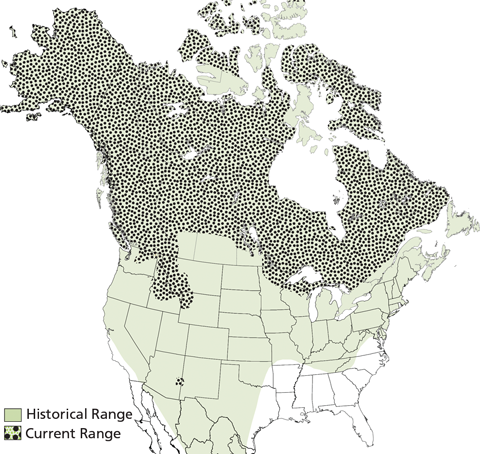
Although wolf packs once roamed from the Arctic tundra to United mexican states, loss of habitat and extermination programs led to their demise throughout nearly of the United States by the early 1900s. In 1973, the U.S. Fish and Wildlife Service (FWS) listed the northern Rocky Mountain wolf (Canis lupus) equally an endangered species and designated Greater Yellowstone Ecosystem (GYE) as ane of three recovery areas. From 1995 to 1997, 41 wild wolves from Canada and northwest Montana were released in Yellowstone. As expected, wolves from the growing population dispersed to establish territories outside the park, where they are less protected from man-caused mortalities. The park helps ensure the species' long-term viability in GYE and has provided a place for research on how wolves may bear upon many aspects of the ecosystem. January 12, 2020, marked the 25th ceremony since wolves returned to Yellowstone.

NPS / Michael Warner
Clarification
Wolves are highly social animals and live in packs. Worldwide, pack size will depend on the size and abundance of casualty. In Yellowstone, boilerplate pack size is 11.viii individuals. The pack is a complex social family, with older members (oftentimes the alpha male person and alpha female) and subordinates, each having private personality traits and roles within the pack. Packs defend their territory from other, invading packs by howling and aroma-marking with urine. Enquiry in Yellowstone since reintroduction has highlighted the adaptive value of social living in wolves – from cooperative care of offspring, grouping hunting of large prey, defense of territory and prey carcasses, and even survival benefits to infirmed individuals.
Wolves swallow a broad diverseness of prey, large and small. They efficiently hunt large prey that other predators cannot usually kill. In Yellowstone, ninety% of their wintertime prey is elk; 10–xv% of their summer prey is deer. They also kill bison.
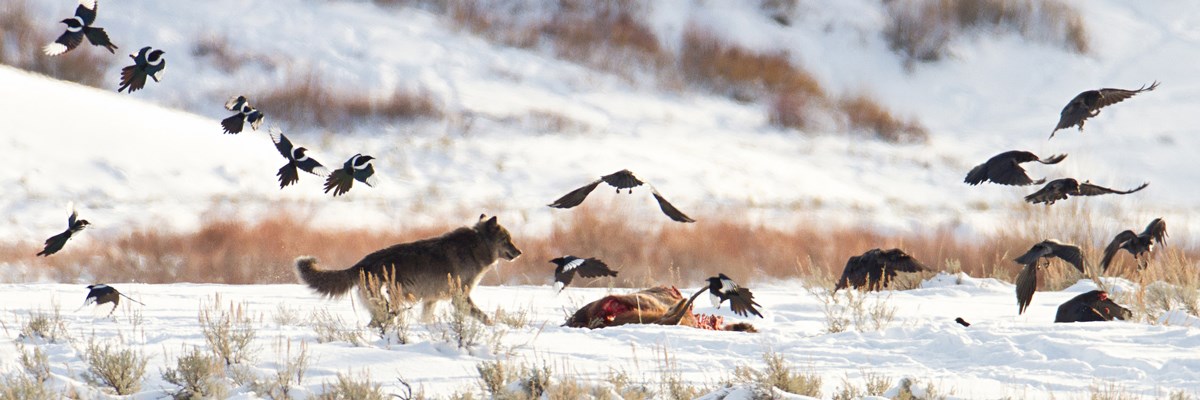
Many other animals benefit from wolf kills. For example, when wolves kill an elk, ravens and magpies make it about immediately. Coyotes go far shortly subsequently, waiting nearby until the wolves are sated. Bears will endeavour to chase the wolves away, and are usually successful. Many other animals—from eagles to invertebrates—consume the remains.
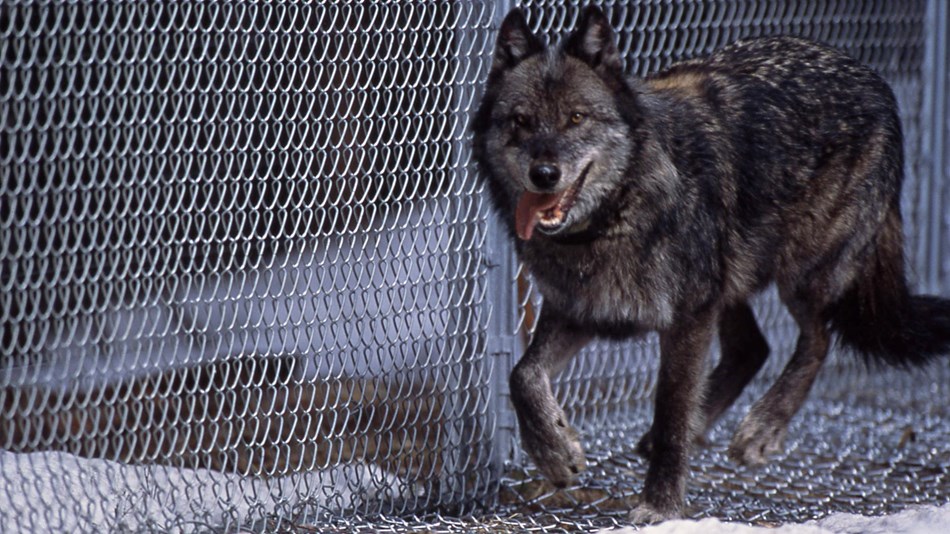
Since reintroduction, genetic studies have evaluated Yellowstone wolves' genetic health, kinship within and between packs, connectivity with other Northern Rocky mountain populations, and even genes linked to physical and behavioral traits. One fascinating discovery involves glaze color. About half of wolves in Yellowstone are dark black in color, with the other one-half mostly greyness coats. The presence of black coats was due to a unmarried gene (a beta defensin gene termed CBD103 or the K-locus), with all black coated individuals carrying a mutation linked to this coat color - a mutation believed to accept originated in domestic dogs of the Old Earth. The origin of the K-locus in wolves likely came from hybridization between dogs and wolves in northwest N America within the last seven,000 years as early humans brought domestic dogs across the Bering State Bridge. In Yellowstone, this discovery set the stage for studies that explored the link between glaze color, reproduction, survival, and behavior. It was plant that the K-locus gene is involved in immune role in addition to causing black coat color, suggesting an boosted part in pathogen defence force. For example, black wolves have greater survivorship during distemper outbreaks. Another report constitute gray wolves to be more ambitious than black colored wolves during territorial conflict, as well as take college reproductive success. During breeding flavor, in that location is besides greater mate option between opposite color male and female pairs compared to same colored pairs. Together, these information suggest fitness merchandise-offs between gray and blackness coat color, prove for the maintenance of the blackness glaze color in the population.
Changes in Their Prey
From 1995 to 2000, in early winter, elk calves comprised l% of wolf prey, and balderdash elk comprised 25%. That ratio reversed from 2001 to 2007, indicating changes in casualty vulnerability and availability. Although elk is still the master casualty, bison has go an increasingly important food source for wolves. While in that location is some predation on bison of all historic period classes, the bulk of the consumption comes from scavenging winter-killed prey or bison dying from injuries sustained during convenance season. The discovery of these changes emphasizes the importance of long-term monitoring to sympathise predator-casualty dynamics. Changes in wolf predation patterns and impacts on prey species like elk are inextricably linked to other factors, such every bit other predators, management of ungulates exterior the park, and weather (e.g. drought, winter severity). Atmospheric condition patterns influence provender quality and availability, ultimately impacting elk nutritional condition. Consequently, changes in prey selection and kill rates through time issue from complex interactions among these factors. Electric current National Park Service (NPS) research focusses on the relative factors driving wolf predation over the by 25 years.
Visit our keyboard shortcuts docs for details
- Duration:
- 5 minutes, 52 seconds
The Northern Range is the hub of wildlife in Yellowstone National Park. Occupying simply 10 percent of the park, information technology is winter range for the biggest elk herd in Yellowstone and is arguably the most carnivore-rich area in North America. Early direction of predators acquired dynamic changes to the ecosystem. The reappearance of carnivores on the landscape has had pregnant and sometimes unexpected impacts on the resident grazers and their habitat.
NPS
Population
In the starting time years following wolf restoration, the population grew rapidly as the newly formed packs spread out to establish territories with sufficient casualty. The wolves have expanded their population and range, and now are found throughout the GYE.
Disease periodically kills a number of pups and onetime adults. Outbreaks of canine distemper occurred in 2005, 2008, and 2009. In 2005, distemper killed twothirds of the pups within the park. Infectious canine hepatitis, canine parvovirus, and bordetella have likewise take been confirmed among Yellowstone wolves, but their effects on mortality are unknown.
Sarcoptic mange, an infection caused by the mite Sarcoptes scabiei, reached epidemic proportions amidst northern range wolves in 2009. The mite is primarily transmitted through directly contact and burrows into the wolf's skin, which can initiate an extreme allergic reaction and cause the wolf to scratch the infected areas, resulting in hair loss and secondary infections. By the end of 2011, the epidemic had mostly subsided; however, the infection is notwithstanding present at lower prevalences throughout the park.
Wolf packs are highly territorial and communicate with neighboring packs by odour-marking and howling. Occasionally packs come across each other, and these interactions are typically aggressive. Larger packs often defeat smaller groups, unless the pocket-sized grouping has more old adult or adult male members. Sixty-five percentage of collared wolves are ultimately killed by rival packs.

NPS
The park's wolf population has declined essentially since 2007, when the count was 171. Most of the decrease has been in packs on the northern range, where it has been attributed primarily to the reject in the elk population and bachelor territory. Canine distemper and sarcoptic mange accept as well been factors in the population turn down.
Each twelvemonth, park researchers capture a small proportion of wolves and fit them with radio tracking and GPS collars. These collars enable researchers to gather data on an individual, and besides monitor the population as a whole to encounter how wolves are affecting other animals and plants within the park. Typically, at the finish of each twelvemonth, but 20% of the population is collared.
Wolves in the Northern Rocky Mountains take met the FWS's criteria for a recovered wolf population since 2002. Equally of December 2015, the United states of america Fish & Wild fauna Service estimated about 1,704 wolves and 95 breeding pairs in the Northern Rocky Mountain Singled-out Population Segment.
The gray wolf was removed from the endangered species list in 2011 in Idaho and Montana. They were delisted in Wyoming in 2016, and that decision was held upwards on entreatment in April 2017. Wolves are hunted in Idaho, Wyoming, and Montana nether land hunting regulations.

NPS
Your Rubber in Wolf State
Wolves are not normally a danger to humans, unless humans habituate them past providing them with food. No wolf has attacked a homo in Yellowstone, just a few attacks accept occurred in other places.
Similar coyotes, wolves can quickly acquire to associate campgrounds, picnic areas, and roads with food. This tin lead to aggressive behavior toward humans.
What You Tin Do
- Never feed a wolf or any other wildlife. Do not go out food or garbage exterior unattended. Make sure the door is close on a garbage tin or dumpster afterwards y'all eolith a bag of trash.
- Treat wolves with the same respect you lot give whatsoever other wild beast. If you come across a wolf, do non approach it.
- Never go out small-scale children unattended.
- If you have a dog, keep it leashed.
- If yous are concerned nearly a wolf—it's too shut, or is not showing sufficient fearfulness of humans— exercise non run. Stop, stand up tall, and watch what the wolf does. If it approaches, wave your arms, yell, flare your jacket. If it continues, throw something at information technology or use bear pepper spray. Group upwards with other people, and continue waving and yelling.
- Report the presence of wolves near developed areas or whatever wolf behaving strangely.
To date, eight wolves in Yellowstone National Park have become habituated to humans. Biologists successfully conducted aversive workout on some of them to discourage being close to humans, but 2 had to be killed.
Current Wolf Management
Wolves are managed by the advisable land, tribal, or federal agencies. Management potency depends on electric current status and location of subpopulations.
Within Yellowstone National Park, no hunting of wolves is immune. Outside the park, Montana, Idaho, and Wyoming regulate and manage hunting. Considering wolves exercise not recognize political boundaries and often move between different jurisdictions, some wolves that alive inside the park for well-nigh of the year, but at times move outside the park, are taken in the hunts.
For current data about management of wolves around Yellowstone visit US Fish and Wildlife Service's web page on the gray wolf.
Wolf Facts
Wolf Restoration
1995 marked the year wolves returned to Yellowstone. Learn more about this journey.
Wolf Q & Every bit
Sentinel the park's wolf biologist answer some questions about wolves in Yellowstone.
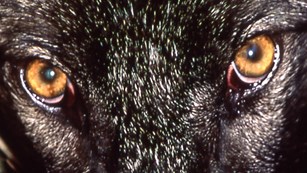
Wolf Reports
Since 1995, the Yellowstone Wolf Project has produced annual reports.
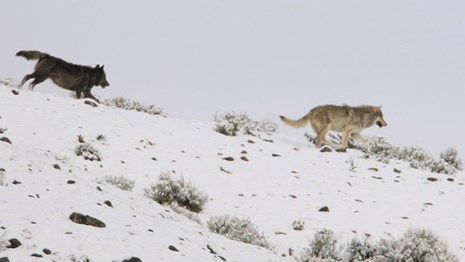
Grayness Wolf Videos
From education videos to raw footage of wolves in the park, explore Yellowstone's collection of wolf films.
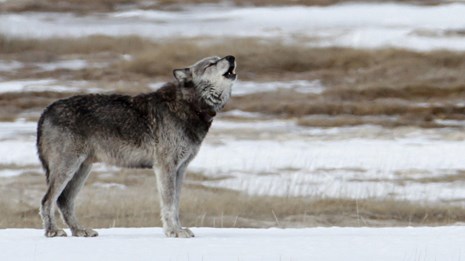
Wolf Sounds
Listen to various wolf sounds nerveless in the park.
Wolf-Related Information
Source: https://www.nps.gov/yell/learn/nature/wolves.htm
0 Response to "How to Draw a Snow Wolf Run Into the Only Thing That Hair Follicles Hurt Again"
ارسال یک نظر